A Night To Remember – by Rob Moseley
This edition of “From the Archives” features Rob Moseley’s account of a night when the skies opened up and revealed a host of astronomical wonders.
This account is a perhaps a timely reminder that we shouldn’t place all our trust in those fancy weather apps.
Sometimes, unexpected changes in the weather can be a good thing!
A Night to Remember By Rob Moseley
Conder Brow Observatory, near Lancaster, is a working observatory co-directed by Denis
Buczynski and David Greenwood. Three domes house 21 inch and 18 inch reflectors, and a 13 inch
Wright Camera. The main work of the observatory consists of astrometric observations of comets
and minor planets. Its results are regularly published alongside those of professional establishments
in the Minor Planets Circular. A good deal of confirmation work is also carried out, either at the
request of Guy Hurst (TA) or Dr Brian Marsden (Central Bureau for Astronomical Telegrams). My
regular visits to the observatory are concerned with photographic measures of double star and
planetary observations.
The evening of August 14th 1989 appeared distinctly unpromising for any active observation. A
ferocious wind, driving in off the Irish Sea, spat a relentless torrent of rain. Heavy cloud had veiled
the summit of Clougha Pike, lying to our East across the valley of the Conder, well before sunset.
Denis and I had resigned ourselves to an evening measuring and reducing existing photographs.
With no real improvement by the early hours of the 15th, plans to photograph Comet Brorsen
Metcalf and observe Jupiter were more or less abandoned. Denis went to bed, leaving me to finish
off some work on the measuring machine.
But how wonderfully unpredictable our weather is!
After a while I become conscious of silence outside. The rush of buffeted trees and singing wires is
suddenly no more. I glance through the window and see the gibbous Moon sinking low in the
South West. 01.20 UT. Still plenty of time before dawnlight will become obtrusive.
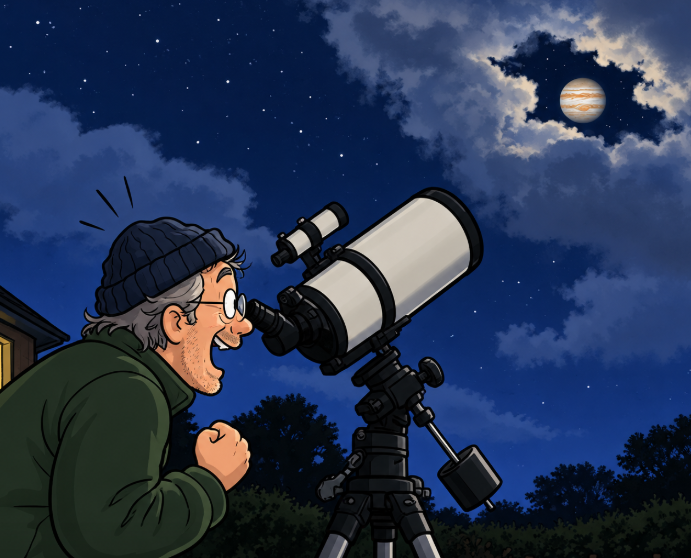
I throw on a coat and walk out to the domes. Looking East great piled masses of moonlit cloud are
rolling away over Clougha Pike. Abruptly Jupiter shines out, already climbing in the North East. I
stand and watch this spectacle for some time. Then, deciding to wait another hour before opening
up the dome of the 21 inch telescope, I turn and start back to the house. Above it, in the North West
sky, hang the draperies of an aurora.
Such is the beauty and sheer unexpectedness of this sight that I am transfixed with delight when I
see it. After a few seconds I break free of the spell and set off at a run along the path back to the
house.
A pounding on a bedroom door, a head stuck round, and the one word “Aurora!” is enough to fetch
Denis tumbling out of bed immediately. Standing on the silent country road to the North of the
observatory I watch the ashen streamers form, melt and re-form, the display stretching round now
from North West to North East, catching Jupiter in its mesh. Denis curses back and forth with
camera and tripod, torn between wanting to simply watch and to record the event. The whole house
is roused now. An excited knot of people in nightclothes, temporarily oblivious to cold, stand in the
midst of a waking dream.
And then, gliding silently across the green sky, a bright Perseid meteor, leaving a smokey train.
Then another. . . and another. We all feel that this show is being laid on just for us,
The aurora continues. The ray bundles form from an arc low in the North, generally intensifying
with a period of about ten minutes, but also pulsating and shifting as we watch. At 02.00 UT a
remarkable rectangular curtain of rays ascends to approximately 50° due North. To me the forms
are an ashen white, although subtle greens and reds are briefly present. The sky background to the
North is a pronounced deep green, which will persist up until dawn. After 02.00 UT the aurora
gradually fades, but quiet glows also last for the rest of the night.
Denis and I now open up the dome of the 21 inch telescope. After a few minutes there is Comet
Brorsen-Metcalf glowing in the field of the 6 inch guide telescope. I see a well condensed coma
with no tail structure visible, although Denis’s photographs have already shown a steadily growing
gas tail on previous nights. “A spring onion comet”, he says. Further exposures are made at the
prime focus of the 21 inch with a driven comet camera – squeezed in after moonset and before
dawn-light.
My friend now bids me a weary goodnight, intent on bed for the second time. Developing the film,
which would normally be done immediately in the darkroom next to the domes, must on this
occasion wait until tomorrow.
The dawn glow is stronger now, but Jupiter still shines like a lamp, at a good altitude in the East. In
this position the eyepiece mount on the 21 inch is impossibly placed over the top of the tube –
besides which the comet camera is still attached. Removing it will mean a good deal of fiddly re
focussing when it is next used. However, the guide for this instrument is on excellent 6 inch F/I9
refractor, so this does not concern me. At 03.05 UT Jupiter is seated in the centre of my field of
view, and I am comfortably seated on the adjustable observing chair. I have a good hour ahead.
The Soutern Equatorial Belt has almost vanished – a fact that Denis and I confirmed with this very
telescope on July I8th, the observation appearing in an IAU Circular. Now it is time to follow up
that early view. Time goes past quickly. In good moments I can still faintly see the Red Spot
Hollow. No definite reappearance of the Red Spot itself yet. If the fading runs to precedent the Spot
itself should become visible during: this apparition. A few transit timings and a disc drawing are
made – but the seeing is not too steady.
By 03.55 UT the lonely call of a lapwing is floating into the dome. The Sun will rise very soon. I
close down, return to the house and linger over a cup of coffee, reluctant to call this night over.
Sitting in the garden I watch the solar disc peep over the shoulder of Clougha Pike.
This article first appeared in MIRA 26, October 1989